Showing posts with label museums. Show all posts

Wednesday, March 14, 2012

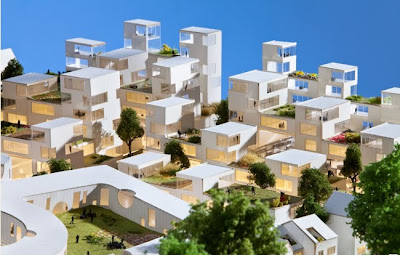
Redesigns for Damaged Communities

A new type of exhibit is open at the Museum of Modern Art, through July 30, 2012.
Foreclosed : Rehousing the American Dream

Alexander J. Felson, Assistant Professor, Yale School of Forestry and Environmental Studies and Yale School of Architecture writes about his role in the study and exhibition.

Creative design and interdisciplinary exchange were two ingredients MoMA sought to foster in the Foreclosed project. Under MoMA’s guidelines, the teams leaped into uncharted territory, investigating new economic models for restructuring suburban land allocation and radical ecological means for management and adaptation. Respecting the location of foreclosures largely on the outskirts of urban areas, the task was to work through design interventions and enhancements, rethinking human-nature relationships given the suburban adjacency to the hinterlands. Team concepts grew organically through discussions, site visits, and research—culminating in a reconfiguration concept coined “misregisration.” This was intended to tweak the suburban model to restructure relationships and take advantage of potential overlaps and adjacencies within the suburb and its surroundings for social, ecological, and economic gains. For example, rather than thinking of each component of the suburb—lawn, driveway, house, and infrastructure—separately, we sought overlaps and slippages that produced multifunctional landscapes and enhanced value.

Click here for the interactive project map with views of current and future urban concepts for each area.


Tuesday, September 6, 2011

Seeing Ground Zero Today


Dear Readers,
I came across this beautiful NG image of Ground Zero where the Twin Towers once stood. It is the New York that survived and is rebuilding to remember those we lost. It seems appropriate to include it now as we mark ten years since the horrific events of 9/11.

The National September 11 Memorial & Museum at the World Trade Center opens to the public next week. Information on the monument and how to reserve free passes to visit may be found at their website: www.911memorial.org.

More views of the rebuilding on the site are available on the EarthCam - World Trade Center Cams.

National Geographic has a thoughtful online exhibit, Starting from GROUND ZERO: Ten years after 9/11, how have the survivors healed—and what wounds still remain?

Sunday, April 10, 2011

Pulp Fashion - Paper Couture

An exhibition at the Legion of Honor in San Francisco features five new spectacular works of paper dresses inspired by paintings in the European collection of the Fine Arts Museums of San Francisco. For more than 15 years, Isabelle de Borchgrave has been recreating historical costumes in exquisite detail, life sized and entirely of paper. Drawing from paintings, textiles, and descriptions, she has made over 60 trompe l'oeil fashion sculptures. Now, they are on view in the US.

Here's an introduction to the exhibit...

"Belgian artist Isabelle de Borchgrave is a painter by training, but textile and costume are her muses. Working in collaboration with leading costume historians and young fashion designers, de Borchgrave crafts a world of splendor from the simplest rag paper. Painting and manipulating the paper, she forms trompe l’oeil masterpieces of elaborate dresses inspired by rich depictions in early European painting or by iconic costumes in museum collections around the world. The Legion of Honor is the first American museum to dedicate an entire exhibition to the work of Isabelle de Borchgrave, although her creations have been widely displayed in Europe."

Above, Marie Claire de Croy and child, 2010 based on the painting below,

Anthony van Dyck (Flemish, 1599–1641), Marie Claire de Croy, Duchess d'Havre and Child, 1634.

Pulp Fashion: The Art of Isabelle de Borchgrave will be on exhibit at the Legion of Honor through June 5, 2011.

Top image: a detail of an elaborate paper sculpture, The Medici

Tuesday, February 1, 2011

17th Century Private Museums Revealed

A new exhibit at the National Gallery of Art, Washington, DC features rare and meticulously rendered catalogues of private collections dating from the 16th and 17th centuries. The documentation includes detailed engravings reproducing the works of art, natural history, and curiosities of these wealthy and sophisticated collectors. Some of the catalogues even include views of the museum rooms and galleries, offering a peek at their curatorial sensibility.

Collections Frozen in Time
Selections from the National Gallery of Art Library
February 5-July 24, 2011

Monday, May 24, 2010

Why Design Now?

Discovering beauty and wisdom in simple forms that use minimal resources. Enabling people around the globe to generate and share wealth. Powering the world with clean energy. As designers tackle these concepts with new products or prototypes they help us address globally relevant social and environmental issues.

Why Design Now? is the title of the fourth installation in the National Design Triennial series, started at the Cooper Hewitt, National Design Museum in 2000. Amongst the sampling of contemporary innovation, the exhibit itself is an environmentally responsible design. Very inspiring.

Reduce, reuse, recycle. Click here for information on the exhibition.

Thursday, September 17, 2009

Domestic Design: Significant Parts

Victor Hugo's Banister from Maison de Victor Hugo6, Place des Vosges, 4th Arrondissement, Paris


Sir John Soane's House, Pitshanger Manor, Walpole Park, Mattlock Lane, London

A shrine is a place preserved for history. A shrine may be where someone important and worth remembering once lived. A shrine is usually preserved to remember a place in time - a long time ago.

I recently came across a book of beautiful photography of everyday objects. The handsome and utilitarian objects are things like architectural details, teapots, clocks, and writing sets. The objects were selected because they were touched by great men.

These objects were touched by great women, too.


Photos from Dr. Johnson's Doorknob and Other Significant Parts of Great Men's Houses by Liz Workman, published by Rizzoli, 2007.

Friday, April 10, 2009

A Canopy of Glass

Over a decade ago, I once sat in a beautiful courtyard in downtown Washington DC. The grassy courtyard had lots of trees and park furniture and paths leading to the entrances of the museum buildings around it on all four sides. Now the courtyard of the Old Patent Office Building has been made more beautiful still and transformed into a delightful new public space with a few improvements, most notably a glass canopy.

The Robert and Arlene Kogod Courtyard of the Reynolds Center of the Smithsonian Institution may be more familiarly known as the short-cut between the National Portrait Gallery and the Smithsonian American Art Museum. The museum complex is housed in a fine 19th century Greek revival structure, a National Historic Landmark, begun in 1836 under architect Robert Mills and completed in 1867 as one of the city's first public buildings.

In its history, the courtyard was also the site of President Abraham Lincoln's second inaugural ball in 1865. The glass and steel canopy was designed by Foster + Partners. "Given the importance of the Old Patent Office, the design was wholly driven by a deep respect for the existing building," Sir Norman Foster said. "It was decided that it should not touch the building at any point but instead float above it like a cloud over the courtyard." The curved glass top, supported by 8 unobtrusive columns, fills the space with light and a feeling of weightlessness as you walk through the 2,800 square foot space watching the shapes of the grid work above appear to undulate.

Landscape architect Kathryn Gustafson contributed to the interior of the space, with the selection of large trees and shrubs and the inviting seating, which are really planters carved of marble. She also designed four very shallow pools of water, adding great drama to the courtyard. Her signature water scrims seem to disappear into the stone floor when not in use.

The space is a remarkable example of history and modern architecture in harmony for the increased usability of the space. And the fabulous result is a place worth visiting and lingering.


Top photo courtesy of David Y. Lee and The New York Times
Bottom photo courtesy of Tim Hursley and the Smithsonian Institution

Lunch is available daily in the Courtyard Cafe 11:30 to 4.