Friday, March 20, 2009

Keep Calm & Consider Alternatives


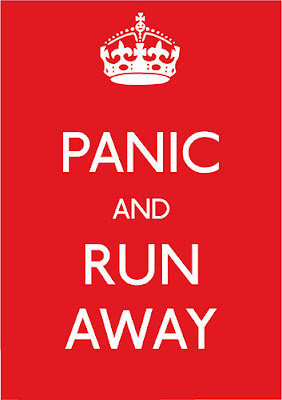
If the original Keep Calm and Carry On message doesn't suit you, here are but a few alternatives to consider:


For more info on any Keep Calm and Carry On parody featured above, just click on the image. See the previous blog entry for the story of the design sensation and original WWII poster saved from obscurity.

Thursday, March 19, 2009

Keep Calm & Carry On

Keep calm and carry on is a great message and a very timely one for us at this exact point in history. It's also a great poster design. The baronial graphic of the crown and the clear Gill font in caps further expresses the simple focus of the message. Well, sure, we can be optimistic with such a thoughtful and charming mantra and a pleasing graphic design to view. I'm feeling better about the world already.

The timelessness of the message and the beautiful simplicity of the graphic elements do not reveal the artist who designed the poster. Now available throughout Great Britain on t-shirts, tote bags, tea towels and door mats, to name just a few, what little is known about it is that it was created as part of a British Ministry of Information propaganda campaign in August of 1939 to alleviate fear of a possible German invasion.

A series of three posters were created under the crown of King George VI, yet only the first two were widely released, appearing on billboards, train stations and shops throughout England. The third design, Keep Calm, was held in reserve, and, thankfully, never needed for its intended use.

Somehow, somewhere, a copy of the unused poster was saved for about 60 years. It resurfaced in a box of old books purchased at auction in 2000 by booksellers Stuart and Mary Manley of Barter Books in Northumberland. They hung the poster in their shop and started to research its origins. Frequent requests to purchase it led them to reproduce the poster and offer it for sale. Some 40,000 copies have been sold through them.

In spite of its wartime origins, the message of resilience is welcome. The archives of British history and design gained a document almost unknown and the rest of us gain the benefits.

Special thanks to Jon Henley for his article Keep Calm and Carry On in the Guardian on March 18, 2009 and Mary Manley's blog entry on March 4, 2009.
Friday, March 13, 2009

Frugalista


frugalista (froog'gal-ees-ta) n. "person who leads a frugal lifestyle, but stays fashionable and healthy by swapping clothes, buying second-hand, growing own produce, etc."

It may not have made the New Oxford American Dictionary's 2008 Word of the Year, but it is a deserving strong finalist. As we face the hard facts of the surround-sound economic crisis crumbling around us – frugalista appears to be a word with staying power. It is a power we’ll need to use as we tighten the belt once again, dust off the sewing machine and serve up dinner of rice and beans for hungry family and friends.

I'm not sure of the protocol regarding new words if they don't yet appear in a dictionary. But it’s such a good word I’m excited to add it to my vocabulary. I would also like to expand its definition. After all, it is such a recent addition to our language certainly the word is still evolving and malleable.

There are plenty of us all over the globe who have learned the art of stretching the wampum, by necessity and practicality. We (hereafter known as frugalistas) know how to make do, quite stylishly, with less. We are not only managing and discovering new ways to do it better, we are also eco-conscious in our choices. From time to time, we might even be a little eco-chic. We reduce, recycle and reuse to the limits of our imaginations.

Special thanks to William Safire for his article On Language - Frugalista in the New York Times Magazine, November 23, 2008 and Natalie McNeal for her blog, The Frugalista Files.

Good looking and sturdy market and tote bags made of earth-friendly materials each sell for under $1.50.

Tuesday, March 3, 2009

Typewriter Style

The height of modern industrial design and portability were exemplified in this new design of the Olivetti Lettera 32 typewriter in 1963. Weighing in at about 13 pounds, this diminutive beauty was a great convenience for students and journalists. With a flick of a switch, the type changed from black to red or no ink for carbon copies.

Design conscious from early on, Olivetti was founded in Italy in 1908. From the 1940s to the 1960s Marcello Nizzoli, (1887-1969) one of Italy's most influential designers, directed product design including the iconic early Letteras. In addition to his role as head product-design consultant, he also worked for Olivetti as an architect, designing housing for employees (1948) and office buildings (1960s).

Click here for a delightful gallery of Olivetti's portable typewriters at the Portable Typewriter Reference Site.

Below are some vintage images of earlier brands of typewriters and their typists/writers and assemblers.
Typing pool, circa 1890

Sales office, circa 1900

Assemblers, circa 1911

These images appear courtesy of The Virtual Typewriter Museum. Please click on over to see all their collections.

Back at 973, the little Olivetti sits out with a piece of paper in the roller at the ready. The grocery list grows; a reminder to return a call is added; and other terrifically important notes are kept in one convenient place in our writing machine.

It's still a great way to communicate!

Saturday, February 28, 2009

Handwrite Your Own Font

Despite warnings that neatness counted and penmanship was graded alongside academic subjects in school, the best handwriting from my pen or pencil ended up closer to chicken scratch. Now I've revisited my sloppy curves and uneven squiggles in an attempt to tidy up my handwriting to create a legible font.

YourFonts is a web-based tool that transformed my combo print/italic scribble-scrabble into a TrueType font free of charge. The process is simple and easily accomplished with a printer and scanner nearby. First, download the pdf template. Second, neatly fill in each box, staying clearly inside the designated boundaries. Third, scan the completed template and upload to YourFonts. Fourth, preview and download your new personalized font.

No more excuses for not writing a personal note!

Thank You

Welcome to our clever crafting friends joining us from One Pretty Thing and Rachel's treasure trove of enticing projects at Daily DIY.

From the traditional craft of quilling papers into beautiful letters to the more immediate gratification of making your own handwriting into a font, the limits of lettering, typography, and design continue to intrigue us at this address.

Tuesday, February 24, 2009

Illuminated Letters


Lettering by hand with serifs and flourishes embellishes your message with beauty, creativity, and thoughtfulness. But you do not have to be an accomplished calligrapher to put together a monogram or a mini missive in a quilled alphabet as illustrated above and below.

The art of quilling or paper filigree is versatile and forgiving for the beginner. For starters, quilling is easy to learn and doesn't require a large investment in tools. Click here for more details on basic quilling instructions.

Shaping letters works best if you curl your paper strips first to condition them. Enlarge your alphabet pattern to the desired size and cut your strips to the approximate length needed for each part of the letter. Shape your strips over the pattern to match the curves of the letters. Glue together the strips as needed to form a single letter. When dry, glue the edges onto your card stock to finish.

For many more great ideas on this paper craft I recommend checking out The New Paper Quilling by Molly Smith Christensen.

Images courtesy of Molly Smith Christensen and Lark Books

Tuesday, February 17, 2009

Diminutive Designs in Cork

The Annual Champagne Chair Contest by Design Within Reach poses the challenge to create an original miniature chair using only the foil, label, cage and cork from no more than two Champagne bottles. The contest rolls around just before New Year's when you might be planning to enjoy a little bubbly. If you are not big on Champagne, they will also accept the recycled cork and foil set-up from any sparkling wine.
Three top winners were selected from the 2009 entries. The Kub Armchair (top) by Jesse Menayan was named as the Judges’ Pick. The Grape Divine Chair (just above) by Tony Nemyer was selected as the DWR Staff Pick, and Spring 2009 (below) by Gavri Slasky won the Popular Vote.
For more information on the contest and where to view a traveling exhibit of the top 50 winning designs, click over to DWR.

Images courtesy of Design Within Reach

Sunday, February 15, 2009

George Washington Sat Here

Great Presidents are remembered for their brilliant leadership and their unconditional loyalty and service to this country. Their papers are studied and preserved for their wisdom and successes. They are copied and reproduced for libraries and textbooks. Great Presidents are also remembered for their everyday domestic objects. These objects are sometimes copied or reproduced, too.

This handsome late 18th century easy chair belonged to George Washington. We are told that Washington sat in this armchair in his bedchamber at Mount Vernon shortly before he died in 1799. Of course, he probably sat in it many times before that.

Photograph of Chair from George Washington's bedroom at Mount Vernon, 1760s-90s,
courtesy of the National Museum of American History, Washington, DC


Photograph of George Washington's Camp Chest courtesy of the National Museum of American History, Washington, DC

Of course, George Washington is not the only President so honored:


Abraham Lincoln's Top Hat is one of the most treasured objects at the Smithsonian Institution. The hat includes a black silk mourning band Lincoln had added in memory of his son Willie. Lincoln was wearing this hat when he went to Ford's Theatre on April 14, 1865. After his assassination, the War Department preserved his hat and other material left at Ford’s Theatre. Courtesy of the National Museum of American History, Washington, DC.

My Valentine

My Valentine's Day surprise.

Saturday, February 14, 2009

British Design Classics by Mail

Royal Mail of Britain has introduced a set of stamps celebrating ten British Design Classics. We weren't surprised to see the English things we love as the Mini, the Routemaster and the red telephone kiosk, K2, among the juried selections. And we were glad to learn our fashion staple, the Mini Skirt, was invented by our fab fave, the very mod designer Mary Quant, who named the skirt after her favorite car. It's a set of stamps we could easily rename Our English Favorites.

We were gratified to see the Concorde, whose design was an English/French collaboration; the Underground map by Harry Beck which resembles beautiful circuitry; the Polypropylene chair we've all sat upon; the Anglepoise lamp which inspired the task lights that illuminate our worktable; and the easily identifiable orange book jacket from Penguin Books.


For more information on this collection of British Design Classics and other philatelic matters click over to Royal Mail.

All images courtesy of RoyalMail.com.

Wednesday, February 11, 2009

A Gift: Homemade Marshmallows

Once or twice a year I pull out my marshmallow recipe and make up a batch to give as gifts. I am always pleasantly surprised to remember that it takes only a few ingredients and is relatively straightforward, albeit sticky. The result is so delicious and remarkably light and fluffy. If you've never tasted a homemade marshmallow you must try it. This confection is probably closer to its mid-nineteenth century French origins than the more commonly known genus that comes in a cello bag.

There are plenty of recipes available to make your own marshmallows. Some call for corn syrup, which I use, others don't. I also like to add the vanilla flavoring early on for a mellower effect. Rather than waiting to add it at the end, I add it to the pan when I dissolve the sugar and salt into the corn syrup and water.

It's just a matter of taste. Enjoy and Happy Valentine's Day!

Monday, February 9, 2009

Quilling for Love


Valentine's Day is a holiday opportunity you won't want to miss to bring out the crafting supplies and make your own card. No more excuses: not enough time, never exchanged cards before, not your style, out of doilies, and on and on.

A homemade card with an expression of love (or like) is a lovely gift in itself. With a little daring inspiration and nimble fingers you can create an amazingly beautiful card just in time for Valentine's Day. The quilled cards above and below are from the archives of Martha Stewart's website, where you will find an excellent tutorial on quilling and many more inspirations for your Valentine's Day expressions.

Using a paper cutter, I trimmed colored paper stock for quilling paper and substituted a round toothpick for a quilling tool. Hearts are easy to start with. Your card design doesn't have to be elaborate or overly decorative to get your message across. A simple heart looks very elegant on a pink or white card.

Make somebody happy with a gift of a card on Valentine's Day!

Photos courtesy of marthastewart.com

Thursday, February 5, 2009

When Art Sparkles & Spins

Unquestionably, Paul Rand (1914-1996) was one of the most influential graphic designers of the 20th century. Among his most famous works are the corporate identities he created for ABC, IBM, UPS and Westinghouse.

But I am also fond of some of his lesser known design projects. Rand worked his graphic magic for young audiences on four children's books elegantly written by his wife, Ann Rand, an architect, and published between 1956 and 1970.

In Sparkle and Spin, his cut-and-paste style art leads the readers around a newspaper trifold hat, up a perch of letters to a bird spouting punctuation, across a chalkboard, past a strip of candy dots and a lollipop man eating a lollipop, under a mound of sand, near an elevated train, behind a chair, through a sampler of borders and fonts, across a breakfast table and onto the dial of a phone (circa 1957). Sparkle and Spin and Little 1 have been republished by Chronicle Books.

Monday, February 2, 2009

Green Under Sunny Skies

On a trip last month to a beautiful resort in sunny Florida I was delighted with the vision of palm trees in groves, luscious landscaping and exotic flowers in bloom. But I was especially impressed to see an established recycling program in full view.

Fortunately, they weren't boasting about being green or self-pronouncing it as an eco-hotel, it was done quite simply as part of their operations. Out-of-doors and around the three or four pools, the free-standing climbing wall, the lawns and the marina there were pairs of teak receptacles. One designated for glass and plastic only while the second was for trash.

A discreet card in the bathroom reminded one of the hotel's laundry conservation program. The hotel will replace bath towels daily upon request, but in an effort to conserve water, energy and reduce pollution they otherwise replace towels and linens every 3rd day for guests in residence. But the most endearing effort was the inclusion of a recycling basket in addition to a trash basket in every guest room. I enjoyed the freedom to recycle in my own room while away from home.


Photographs taken at the Hyatt Regency Coconut Point Resort and Spa in Bonita Springs, Florida.

Monday, January 19, 2009

The Design Matters

Clean, clear designs are appealing whether they were made in the early part of the century or just last year. We are drawn to a brand new retro looking design as if it were an old book unearthed in a antiquarian bookshop. The graphics, lettering and design affect our emotions before we may even have time to read the title and digest the subject. Our highly developed sense of aesthetics guide us to pick up that book with the beautiful cover or that product with the striking label. Great design makes the identity of a product enticing.

The work of Louise Fili, whose cover art appears above, takes her viewers into a world of exquisite design with references to typography and layout evoking a different place and time while creating a strikingly clean, clear and modern identity. She makes her products so appealing, it's hard to imagine living without them.

Here are a few inspiring examples from her recent work.


Images courtesy of Louise Fili Ltd.

Saturday, January 17, 2009

Seal of Approval

One hundred years ago, the Good Housekeeping magazine first published research on approved products for the modern homemaker. They went on to create an Experiment Station in 1900 to study food and household products against false advertising claims. The approved products were listed on an honor role. In 1909 a new testing facility with a model kitchen and domestic science laboratory was built as the Good Housekeeping Institute. The list of tested and approved products and machinery was published in December 1909 with the first seal of approval.
A version of the first seal design was in use until 1941, when the magazine added the guarantee that if a product was not as advertised, a replacement or a refund would be provided to the consumer. The appearance of the seal changed several times over the next six decades of consumer protection as the wording of the promise evolved.

To celebrate the big anniversary and the 1911 purchase by the Hearst Company, Louise Fili, the very talented and prolific graphic artist, book cover designer, food product designer and restaurant and logo designer, was brought in to update the Good Housekeeping seal.

A recent New York Times article quoted the designer on this project. "The thing about doing any kind of redesign of something that well known,” Ms. Fili said, “is that you have to keep at least one element so people can make the leap. In this case it was the oval and the star, so not just the baby boomers would be able to recognize it.”

Her redesign was so convincingly timeless that there was a little confusion on the Today show where the blue and red 1990s seal was mixed up as the newer one and her design referred to as the old design. Fortunately, she took it as a compliment.

Images courtesy of Good Housekeeping and the New York Times.

Thursday, January 8, 2009

London's Red Bus Goes Green

The iconic image of the Routemaster double-decker bus of London has been preserved and reinvented for the 21st century. The Mayor of London announced the winners of a design competition, A New Bus for London, sponsored by Transport for London. The competition, open to all interested parties, was seeking stylish (as good looking as the old favorites) and imaginative (green and greener) designs for a new and better bus for the city of London.

Well-known British automaker Aston Martin worked together with architects Foster+Partners on their winning entry pictured above. They share the top prize with the entry from Capoco Design Ltd., pictured below.

Upon its introduction as a prototype in 1954, the Routemaster was considered the most modern double-decker bus in the world. The Routemaster remained in regular service throughout the city until 2005. Vintage Routemasters can still be found on at least one heritage route in London. Of course, the beloved design image can easily be found on souvenirs all over the city.

Photos courtesy of Transport for London

Monday, January 5, 2009

The Twelfth Night Brings One More Chance to Give


The holiday season isn’t over just yet. On the Twelfth Night of Christmas in cities and towns throughout Italy, children leave stockings and shoes out in hopes of a gift on January 6th from la Befana, the old beneficent witch, who flies through the sky on her broom. She leaves gifts of toys and sweets for good children. And for those naughty ones? You guessed it: Coal.

On this last night of a more-than-a-little-uneven holiday season, why not pick out that one rotter on your list and let them know how you really feel? Remember, it’s 354 days ‘til Christmas comes around!

Carbone dolce (sweet coal) is a black candy that looks awful, but tastes sugary sweet. It turns your tongue black. It’s widely available in Italy in the weeks leading up to the Feast of the Epiphany. Most candy shops here sell Santa’s coal, or something like it. Your recipient will get the hint.